
Green Rush Advisory Group, LLC • October 4, 2026
Congress helped create a market. Businesses built livelihoods around it. Now the economic consequences of restricting that market have become an argument for keeping it open.
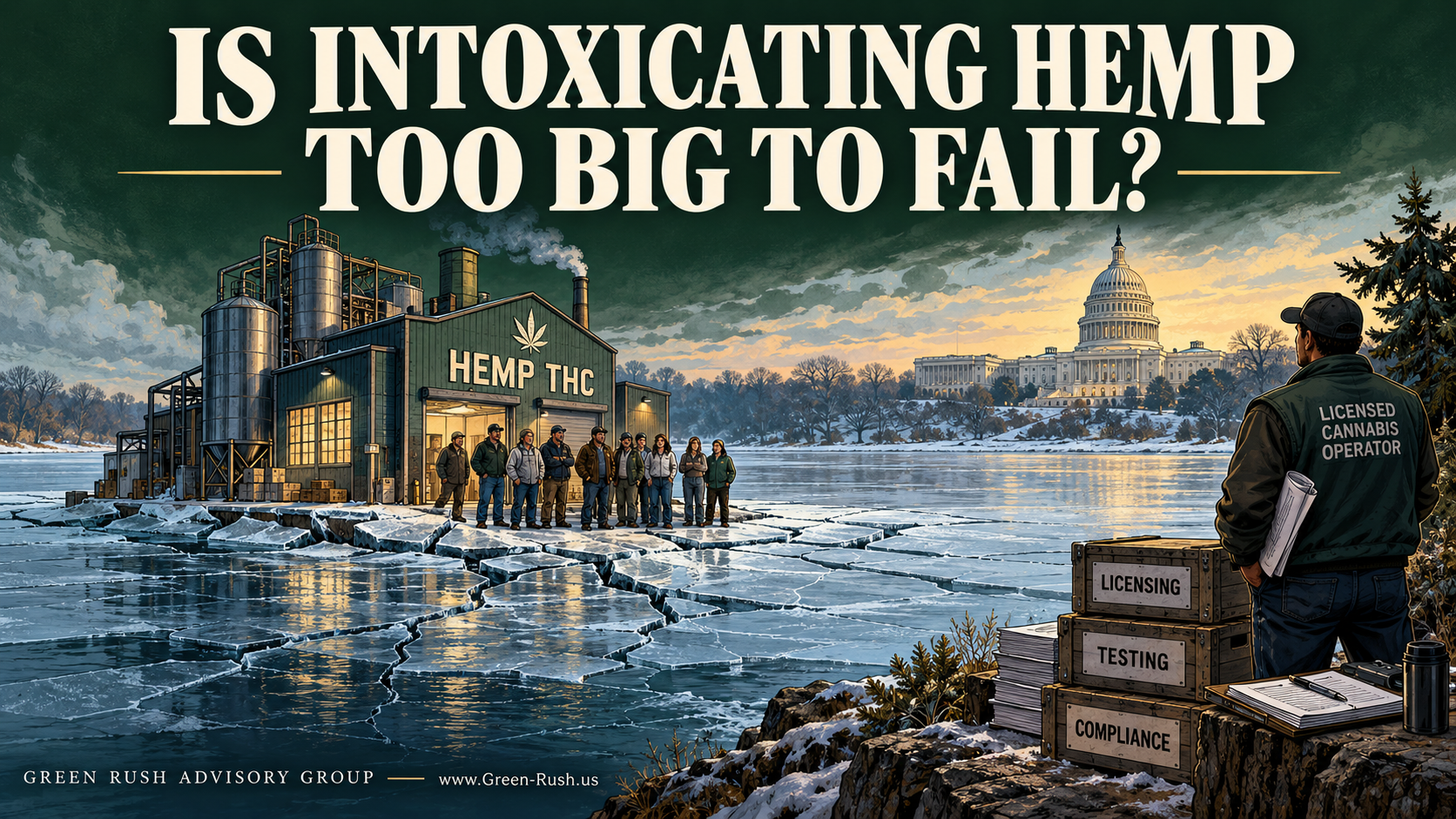
Is this the intoxicating-hemp industry’s “too big to fail” moment?
The Associated Press reports that a Whitney Economics estimate places the threatened market at $28.3 billion and 225,000 jobs. Those are economic estimates, not a verified count of inevitable layoffs. They nevertheless frame a serious political question: What responsibility does Congress bear when its own legislation creates an opening, and years pass before that opening is meaningfully addressed? And what about the businesses that knowingly invested in the fragility of operating within a loophole?
Where would the state-licensed cannabis operator fit into a potential rescue of intoxicating hemp products. What rules and regulations would bring equity for the people who invested in complying with demanding cannabis rules, regulations and market restraints.
Congress wrote the opening
Precision matters when assigning blame. Congress wrote the 2018 Farm Bill’s hemp definition. Federal agencies inherited the task of administering and enforcing the laws surrounding it.
That definition included cannabis derivatives, extracts, and cannabinoids containing no more than 0.3% delta-9 THC by dry weight. A concentration threshold is different from a limit on the intoxicating dose in a finished product. A 5-gram product at that concentration contains 15 milligrams of delta-9 THC. The arithmetic illustrates the policy problem; it does not establish that such a product satisfies every applicable law. See the statutory definition and amendment notes.
Congress left a consequential gap between the agricultural concept of low-THC hemp and the commercial possibilities of finished cannabinoid products.
Federal agencies did issue warnings. FDA has maintained that the Farm Bill preserved its authority and that introducing foods with added THC or CBD into interstate commerce is prohibited under the applicable food and drug provisions. Its record includes warnings concerning CBD and delta-8 products. Describing the government as entirely silent would be inaccurate. FDA’s regulatory guidance and enforcement history make that clear.
But warnings and fragmented responses did not provide a durable national settlement. It would seem that Congress bears particular responsibility for allowing that unresolved conflict to persist until changing course carried much larger economic consequences.
Every additional year gave businesses more time to hire, expand, sign leases, and develop customers. Political delay allowed commercial dependence to deepen. That dependence now gives the industry a powerful argument against the correction.
Some businesses knowingly skated onto thin ice
Government responsibility does not erase business judgment.
The AP article describes one manufacturer who initially expected a short commercial window and limited capital investment because he anticipated government intervention. That is evidence of one operator’s awareness, not proof of everyone’s intentions.
Still, sophisticated businesses deliberately marketing intoxicating products through the hemp exemption had reason to recognize the vulnerability of the model. A favorable reading of one statutory definition could not guarantee permanent market access.
There is a fair “you should have known better” edge here, provided we are clear about what they should have known: that a business depending on a contested regulatory distinction carried a substantial risk of intervention.
Owners who expanded under those conditions also made decisions affecting their employees. Hiring people does not convert a risky regulatory strategy into a public guarantee. When executives ask Congress to protect their workers, it is reasonable to ask what they did to prepare those businesses for a foreseeable change.
Workers deserve consideration regardless of management’s choices. They generally have less control over the business model and fewer opportunities to protect themselves from its failure.
Nor should every hemp farmer be assigned the same responsibility. Growing fiber or grain, supplying a processor, and deliberately formulating intoxicating consumer products involve different decisions and different knowledge of downstream uses. Accountability should follow those distinctions.
The licensed cannabis industry has a fairness claim
For licensed cannabis operators, compliance is a continuing expense.
Washington’s cannabis rules, for example, address applicant qualifications, security, traceability, recordkeeping, testing, packaging, taxes, inspections, and changes in ownership or location. These obligations shape how businesses are financed, built, staffed, and operated. Chapter 314-55 WAC shows the breadth of that framework.
Hemp requirements vary by jurisdiction and product. It would be inaccurate to claim that every hemp business operates without oversight. The fairness problem arises wherever competing intoxicating products reach consumers under materially different obligations.
If Congress decides that hemp-derived intoxicants deserve a permanent commercial pathway, licensed cannabis stakeholders are entitled to ask why comparable products should carry substantially different compliance costs.
The jobs argument must include both sides of that competition. Protecting one sector while preserving an unjustified cost advantage could put employment and investment in the other sector under additional pressure.
What protection should require
“Too big to fail” is a political analogy here. The industry is seeking continued market access rather than a conventional taxpayer bailout. But the incentive problem is recognizable: grow around a vulnerable policy opening, accumulate enough economic importance, and argue that closing the opening has become unacceptable.
Congress could choose another temporary extension. That would offer breathing room while leaving the underlying conflict unresolved. A lasting compromise would require much more.
It could start with a common principle: comparable intoxicating products should face comparable safeguards, regardless of whether their cannabinoids originated in legally defined hemp or marijuana.
That should include meaningful age verification, independent testing, accurate potency labels, appropriate packaging, enforceable manufacturing standards, and records sufficient to investigate contamination and conduct recalls. Requirements should reflect dose, product type, manufacturing process, and risk.
Congress would also need to address access to the market. If a new federal framework allows qualifying hemp products into ordinary retail or interstate distribution, lawmakers should explain how existing cannabis businesses can participate in that opportunity. Otherwise, a rescue could formalize the very competitive imbalance that needs correcting. Federal legislation and state policy changes would have to work together; Congress cannot resolve every state licensing difference with a hemp amendment.
Tax treatment belongs in that discussion. So do licensing fees and duplicated compliance requirements. Fairness does not require imposing every existing cannabis expense on hemp businesses. It requires examining which burdens serve a legitimate purpose and reducing unnecessary burdens for existing cannabis operators as well.
A transition should have deadlines and measurable obligations. Continued operation could be conditioned on registration, testing, labeling, and progress toward the applicable approvals. Workers and farmers need a practical transition plan. Businesses need a credible destination beyond the next postponement.
Congress must account for both industries
No reform can perfectly refund the years of compliance spending already incurred by licensed cannabis businesses. Protecting their investments also cannot mean guaranteeing them freedom from competition.
But Congress should not reward reliance on an unresolved loophole with a permanent advantage over businesses that followed a more demanding path.
The strongest case for protecting employment is a case for building a coherent market. It should require intoxicating-hemp businesses to accept enforceable responsibilities and give licensed cannabis operators a fair opportunity to compete.
Congress helped create the conditions behind this “too big to fail” test. Business owners chose how far to skate onto the ice. Employees should not be treated as expendable, and compliant cannabis operators should not be treated as an afterthought.
If politicians decide the industry is too important to lose, they must also decide that consistent rules are too important to postpone.