Virginia’s Cannabis Licensing Draft Is Here: Proposed Fees, Operating Requirements and What Applicants Should Do Next
An applicant-focused review of the CCA’s September 9 meeting and 82-page initial regulatory draft.
By Ford T. Pearson | Green Rush Advisory Group
September 11, 2026
For anyone preparing to enter Virginia’s adult-use cannabis market, the questions are becoming more concrete: What will the government fees be? Who must be disclosed? What staff, security systems and facilities will the business need? And when can a particular applicant actually submit an application?
The September 9 developments provide more material to work with. They also require discipline: prospective operators need to distinguish enacted law, proposed regulations, agency implementation targets and details that remain unresolved.
Virginia’s Cannabis Control Authority has released an 82-page initial regulatory draft dated September 9, 2026. For prospective licensees, that changes the preparation task: proposed fees, staffing standards, security specifications, and testing procedures can now be assessed against a real business plan.
The draft has not been adopted as final regulations. During the September 9 Board meeting, staff emphasized continuing review, stakeholder input, and Public Health Advisory Council involvement. The meeting did not announce a replacement for the July 1, 2027 retail-sales date. Watch the CCA meeting
The application calendar is phased
The CCA’s published schedule identifies Council review beginning in October, completion of review and regulatory finalization in December, and publication and effectiveness in January 2027. Staff described December final Board review and January processing toward the February 1 statutory deadline.
-
By February 1, 2027: conversion applications open for pharmaceutical processors and qualifying industrial hemp processors or growers, and the application process for some microbusiness licenses begins.
-
By May 1, 2027: the CCA must issue certain initial licenses.
-
July 1, 2027: retail marijuana sales are scheduled to begin.
This is a phased opening. Prospective standalone retailers, laboratories, transporters, and other applicants should await the notice for their specific license type. A regulatory draft is not an application form or an open submission window. CCA implementation schedule
Proposed fees: what the draft actually says
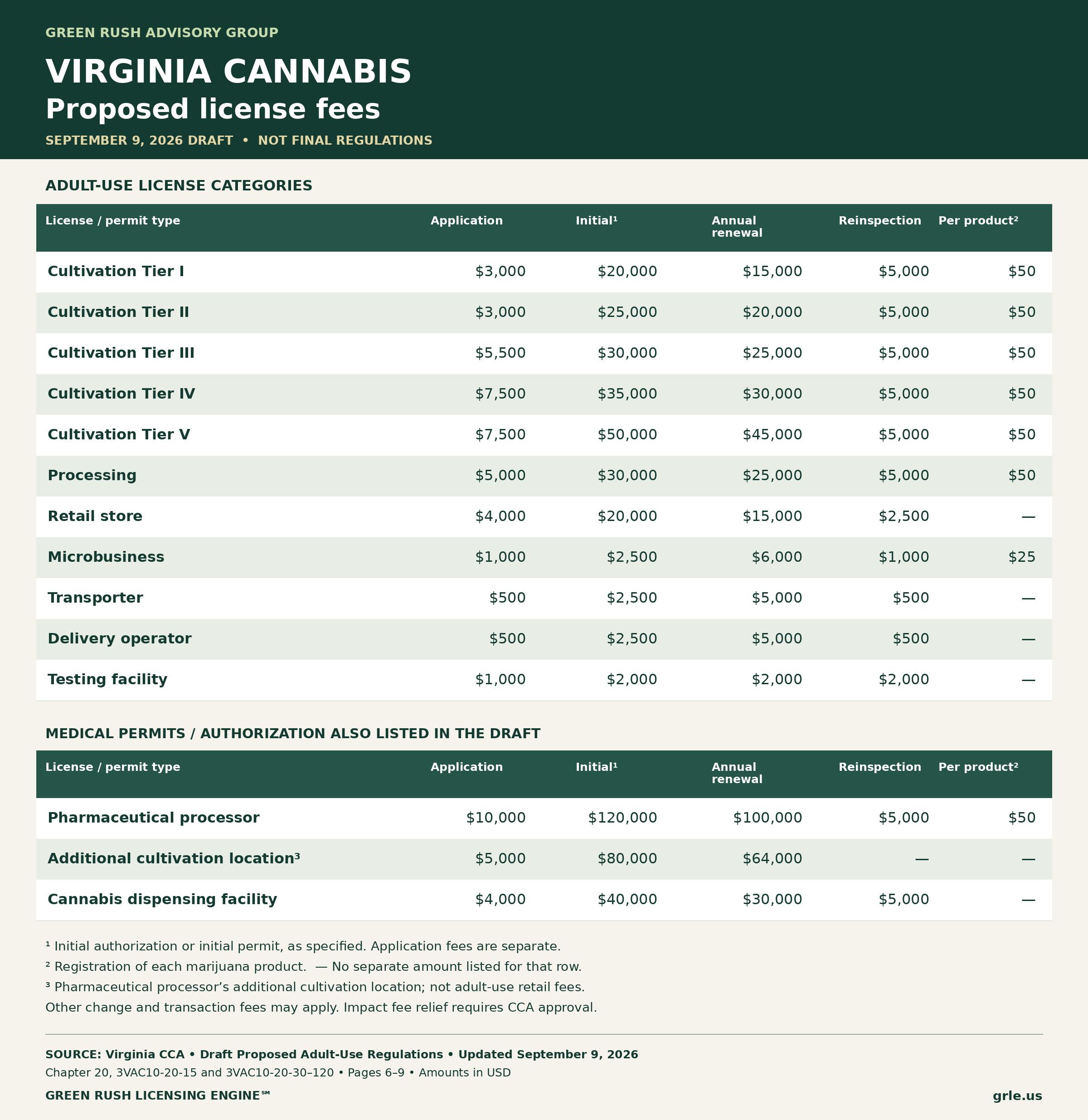
The September draft supplies the following government fees. All figures below are proposed, not final; initial authorization and annual renewal are separate charges at different stages.
| License type | Application | Initial authorization | Annual renewal |
|---|---|---|---|
| Cultivation Tier I | $3,000 | $20,000 | $15,000 |
| Cultivation Tier II | $3,000 | $25,000 | $20,000 |
| Cultivation Tier III | $5,500 | $30,000 | $25,000 |
| Cultivation Tier IV | $7,500 | $35,000 | $30,000 |
| Cultivation Tier V | $7,500 | $50,000 | $45,000 |
| Processing | $5,000 | $30,000 | $25,000 |
| Retail store | $4,000 | $20,000 | $15,000 |
| Microbusiness | $1,000 | $2,500 | $6,000 |
| Transporter | $500 | $2,500 | $5,000 |
| Delivery operator | $500 | $2,500 | $5,000 |
| Testing facility | $1,000 | $2,000 | $2,000 |
For a retail applicant, the proposed application and initial authorization fees total $24,000 before premises, buildout, security, inventory, professional services, or working capital. For a microbusiness, those two fees total $3,500, but the proposed $6,000 annual renewal and integrated operating requirements need separate attention.
The draft also includes reinspection fees, product-registration charges, and a $5,000 fee for an acquisition, expansion, remodel, or location change requiring inspection. Qualified impact applicants could request a discretionary fee reduction or waiver at initial or renewal application. A waiver would require approval; it is not automatic. Medical processor and dispensing-facility schedules are separate from the adult-use figures above.
Microbusiness applicants need an integrated operating plan
Draft 3VAC10-30-130(H) would require a microbusiness to engage in commercial cultivation, processing, and retail sale, with all functions operational within 18 months after the license is issued unless an extension is granted for good cause. A plan that assumes a microbusiness can perform only one of those functions needs to be revisited.
The draft would allow impact licensees and microbusinesses to request CCA approval for cooperative agreements, leased space and equipment, and shared processing. Each participant would retain tracking, recordkeeping, and security duties unless the Board authorizes otherwise. The one-outdoor-license restriction for a parcel or contiguous parcels under common ownership or control remains relevant. Shared premises are a potential strategy requiring approval.
Ownership and staffing deserve an early review
The proposed “material owner” definition includes any security or beneficial interest in a privately held entity. For publicly traded entities, it includes certain board-appointment rights or holdings of at least 5%. Collecting only owners above a 10% threshold would miss potentially relevant interests.
The draft would require a responsible party employed full time in a managerial role and actively engaged in daily operations, serving only one establishment or regulated hemp retail facility at a time. For cultivation, processing, and microbusiness operations, the responsible-party provision calls for at least two years of verifiable plant-cultivation or chemical-extraction experience. Initial employee training would precede work, with in-service training at least annually.
Security, inventory, and delivery affect facility costs
Proposed controls include monitored alarms with backup power, restricted access, camera coverage of cannabis areas and entrances, continuous recordings retained for at least 30 days, and additional outdoor security. The draft also specifies weekly inventory, monthly reconciliation, and three-year retention for inventory, laboratory, and sales records.
For delivery and transport, the proposal calls for written CCA approval before advertising, offering, or starting those services, plus driver and vehicle disclosures, Virginia registration and insurance, secured storage, GPS, manifests, and daily equipment checks. Delivery hours would be 6 a.m. to midnight, and GPS records would be retained for at least 90 days.
At the meeting, staff identified Metrc as the seed-to-sale system being expanded from the medical program and OpenGov as the licensing and enforcement system under development. These are useful planning signals for systems and training; they do not establish that an adult-use application portal is open.
Product and laboratory proposals add measurable requirements
For the existing two-ounce transaction limit, the draft proposes an equivalence of eight grams of concentrate or 800 milligrams of THC in edible products. Those are transaction equivalents, not permission to put 800 milligrams into a single edible package.
Laboratory applicants would need to address independence, qualified scientific oversight, controlled-substances registration, ISO/IEC 17025 accreditation or the proposed application pathway, and transport protocols. The proposed sampling rules set maximum batches of 50 pounds for botanical cannabis and 20,000 sale units for concentrate products, with a sample of at least 0.5% of batch mass. Sampling would be recorded, chain of custody documented, and batches held pending results.
Packaging would need to be child-resistant, tamper-resistant, and opaque, supported by child-resistance certification. Labeling proposals include product and batch identification, testing information, ingredients, cannabinoid content, warnings, and an expiration date. Product-name registration and recall procedures would also be required.
Several questions remain unresolved
Some license caps still appear as “X” in the draft. Staff said market-analysis feedback was expected around the end of October. Neither the draft nor the meeting supports a new numerical cap for those categories.
Several draft provisions also warrant legal reconciliation before reliance:
-
Selection: the draft’s “lottery, or similar process” language differs from the statute’s mandatory lottery when qualified demand exceeds available licenses.
-
Criminal history: proposed material-owner and employment restrictions must be read against statutory lookback periods and marijuana-offense protections. They should not be used as an automatic screening rejection.
-
Locations: the draft uses school/daycare setback language across establishments. The enacted retail and microbusiness framework names additional sensitive uses, and local distance-reduction authority also requires consideration.
Final application notices, submission fields, fee adoption, specific license availability, and official interpretations remain essential. A preliminary approval also does not authorize operations.
What prospective applicants can do now
A useful preparation process starts with the decisions that determine the rest of the project:
-
Choose the operating model. Identify the activities the business intends to perform and match them to the relevant license privileges. A retail-only business and an integrated microbusiness require very different facilities, staff and capital.
-
Document the people and financing. Build an ownership and control record that captures beneficial interests, management roles and financing relationships. Identify questions requiring CCA clarification or legal review before making an eligibility claim.
-
Test the proposed location. Review local land-use requirements, sensitive uses, site control, utilities, security and the activities contemplated for the premises. Keep unresolved statutory and draft-rule issues visible in the analysis.
-
Build a complete budget. Separate application and authorization fees from ongoing renewal costs, buildout, equipment, testing, tracking, insurance, professional services and working capital. For microbusinesses, test the cost of bringing all three operating functions online.
-
Prepare the supporting evidence. Translate relevant provisions into ownership records, experience documentation, operating procedures, site plans, security designs and vendor specifications. Draft rules can guide preparation without being represented as final application instructions.
-
Maintain a dated source record. Record which conclusions come from enacted law, which depend on the September draft and which require a future notice or interpretation. Update the plan when the CCA publishes the next controlling document.
These are preparation steps, not a representation that an application window is open or that completing a checklist guarantees a license.
From a regulatory draft to a workable business plan
Before September 9, much of the preparation work centered on the enacted framework and questions awaiting CCA definition. The initial draft now supports more specific fee scenarios, staffing plans, security budgets, and operating-model tests. Green Rush has updated its Virginia guidance accordingly, including correcting a broad February application-opening description to reflect the phased schedule. Earlier requirement counts describe an earlier inventory; they should not be treated as a complete assessment of the new 82-page proposal.
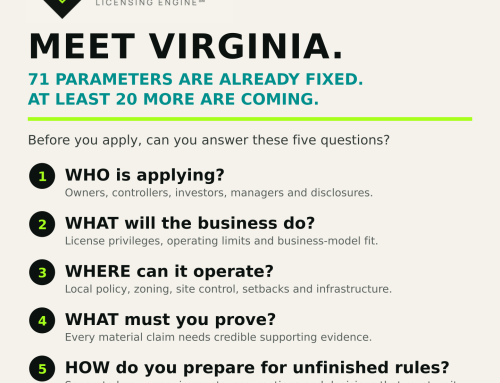
Green Rush’s proprietary Who–What–Where approach organizes the preparation around the ownership group and responsible people, the license type and intended activities, and the locality and premises. The practical task is to connect each relevant requirement to the evidence and cost behind the project, while keeping draft provisions visibly conditional. Green Rush’s $5,900 Virginia Cannabis Licensee Readiness Report examines one ownership group, one principal license pathway, and one target jurisdiction. The $2,900 Location Vetting service addresses a specific contemplated use and locality or property.
Explore Virginia license readiness
This update reflects the September 9 draft, the CCA meeting, and official guidance reviewed September 11, 2026. It is consulting information, not legal advice or a guarantee of licensure. Draft provisions may change before adoption.