Preparing for a Virginia Cannabis License: The Work Begins Before the Application Opens
Virginia’s cannabis regulations are unfinished. Your preparation doesn’t have to be.
Virginia has authorized a regulated adult-use cannabis market. The Virginia Cannabis Control Authority is now responsible for developing the regulations, application procedures and administrative infrastructure needed to implement it.
Under the current implementation timeline, the CCA is expected to adopt retail marijuana regulations and begin accepting applications for some license types by February 1, 2027. Initial licenses are expected to be issued by May 1, 2027, and legal retail sales may begin July 1, 2027.
That may sound like applicants have months to prepare.
They do not.
There is a meaningful difference between waiting for the application window to open and waiting to begin the work required to complete, perfect and submit a competitive Virginia cannabis license application in a timely manner.
An application window is not the beginning of the licensing process. It is closer to the point at which an applicant must prove that months of planning, investigation, documentation and strategic decision-making have produced a viable enterprise.
The work begins with three deceptively simple questions:
Who is applying?
What does the applicant intend to do?
Where can the proposed business legally and practically operate?
The questions are simple. Producing complete, accurate and mutually consistent answers is not.
A License Application Is a Connected System
Cannabis applications are often discussed as though they are forms: enter the company name, identify the owners, select a license and provide an address.
A serious application is better understood as a connected system of representations.
The ownership documents must agree with the capitalization plan. The capitalization plan must agree with the source-of-funds documentation. The proposed license must authorize the activities described in the operating plan. The operating plan must fit the building. The building must fit the zoning. The equipment plan must fit the available power and utilities. The security plan must fit the premises. The construction budget must fit the applicant’s available capital. Every material assertion may need credible supporting evidence.
A weakness in one area can travel through the entire application.
Changing an investor may alter ownership disclosures, background investigations, control analysis, financing documents and organizational agreements.
Changing a location may affect zoning, site control, security design, construction estimates, utility requirements, transportation logistics, community engagement and the economic assumptions behind the business plan.
Changing the license pathway may alter what the business may purchase, possess, cultivate, process, transport, deliver or sell. It can also change premises requirements, equipment needs, staffing assumptions, supply-chain relationships and projected capital requirements.
This is why cannabis licensing requires precision. The challenge is not merely answering individual questions. It is making certain that hundreds of interdependent answers describe the same enterprise.
WHO: The Applicant Is More Than the Name on the LLC
The first layer of preparation concerns the people and entities behind the proposed applicant.
Virginia law already provides meaningful information about ownership, control and management. For example, the statutory definition of a “principal” reaches certain individuals who own or control at least five percent of an entity, possess corresponding voting power or manage marijuana-establishment operations on behalf of a licensee.
That immediately creates work.
A prospective applicant may need to identify and evaluate:
-
Direct and indirect owners
-
Voting and nonvoting interests
-
Managers and operational decision-makers
-
Investors and lenders
-
Parent companies and affiliated entities
-
Options, convertible instruments and contingent ownership rights
-
Profit-sharing and revenue-sharing arrangements
-
Spouses or immediate family interests where relevant
-
Consultants whose authority could be interpreted as management or control
-
Individuals whose backgrounds or financial relationships may create eligibility concerns
The organizational chart cannot be aspirational. It must reflect the applicant’s actual ownership and control structure.
The operating agreement cannot say one thing while a side agreement gives another person practical control.
A lender cannot be presented as a passive creditor if the loan documents provide the lender with extensive operational authority, unusual profit participation or rights that resemble ownership.
An investor cannot simply be removed from a disclosure schedule because the parties would prefer to characterize that person as something else.
These distinctions require document-by-document analysis. They may involve formation records, operating agreements, subscription documents, capitalization tables, loan agreements, management agreements, consulting contracts, intellectual-property licenses and other arrangements through which money, authority or economic benefits move.
Before an application can describe the applicant accurately, the applicant group must understand itself accurately.
WHAT: The Business Model Must Fit the License
Virginia’s framework contemplates several license pathways, including cultivation facilities, processing facilities, testing laboratories, transporters, delivery operators, retail stores, dual-use operations and microbusinesses.
Those are not interchangeable labels.
Each license carries specific privileges, limitations and relationships with other participants in the regulated supply chain. Selecting a license requires considerably more than deciding whether the founders would prefer to “grow,” “process” or “open a dispensary.”
A prospective applicant must identify every material activity contemplated by the business:
-
What will the company acquire?
-
From whom may it acquire it?
-
What may it possess?
-
What may it cultivate or manufacture?
-
Where may those activities occur?
-
What may it transport?
-
To whom may it transfer or sell?
-
May it sell directly to consumers?
-
May it conduct delivery?
-
What portions of the operation require another license or endorsement?
-
Which proposed revenue streams are actually authorized?
-
Which relationships with affiliated companies are permitted?
-
Which activities must be conducted by independent licensees?
Virginia’s retail-store statute, for example, addresses permissible sources of inventory, consumer sales, delivery methods, transaction limits, inventory tracking, employee training, security and sanitation. It also prohibits drive-through sales and automated dispensing, restricts delivery to certain destinations and prohibits fulfillment through third-party Internet sales platforms.
The microbusiness pathway adds another layer. Virginia law authorizes a microbusiness to conduct certain cultivation, processing and retail activities determined by the Board, but it places limits on canopy, other license holdings, premises and the locations at which particular privileges may be exercised.
A business model built without mapping these statutory privileges can be commercially attractive and legally incompatible at the same time.
That incompatibility may not become obvious until substantial money has already been spent on a site, equipment, architectural plans, branding or contracts.
A disciplined applicant therefore develops the operating model and the license strategy together. Neither should be treated as an afterthought to the other.
WHERE: A Promising Property Is Not Necessarily a Licensable Premises
Location is frequently where cannabis projects absorb the most capital and encounter the most painful surprises.
A property can have adequate square footage and still be unsuitable. It can be correctly zoned for one use but not another. It can appear affordable before the applicant calculates power upgrades, ventilation, wastewater handling, security construction, fire-code compliance, accessibility improvements, odor mitigation and landlord requirements.
A proper premises analysis may need to examine:
-
Local cannabis policy
-
Zoning classification
-
Conditional-use or special-use procedures
-
Separation and setback requirements
-
Proximity to schools or other protected uses
-
Local licensing or permitting
-
Site-control requirements
-
Lease contingencies
-
Landlord consent
-
Building and fire codes
-
Certificate-of-occupancy requirements
-
Power availability
-
Water and wastewater capacity
-
HVAC and environmental controls
-
Loading and transportation access
-
Security layout
-
Surveillance coverage
-
Product-storage areas
-
Restricted-access areas
-
Waste-handling procedures
-
Odor-control requirements
-
Construction costs and timelines
-
Community and political conditions
Virginia law requires a licensee to maintain possession of its licensed premises. Losing possession can result in license revocation. That makes the lease, purchase agreement or other site-control instrument part of the regulatory foundation of the enterprise—not merely a conventional real-estate document.
At the same time, committing too early can expose the applicant to months of rent, deposits, engineering expenses and construction obligations before final regulatory requirements are known.
The correct answer is neither “secure a property immediately” nor “ignore real estate until applications open.”
The correct answer is to investigate aggressively, model carefully and commit selectively.
A prospective applicant can evaluate jurisdictions, identify candidate properties, test zoning, investigate utilities, develop site criteria, estimate improvement costs and negotiate protective contingencies without pretending that every unresolved regulatory question has already been answered.
The Evidence Problem
Cannabis applications do not merely ask applicants to make claims. They frequently require applicants to prove them.
An applicant may claim that it has adequate capital, an eligible ownership structure, lawful site control, a compliant premises, relevant experience, suitable security, responsible operating procedures and the ability to become operational.
Each assertion invites another question:
What evidence supports it?
Proof may eventually include:
-
Formation and governance documents
-
Ownership and capitalization records
-
Personal and business financial statements
-
Bank records
-
Loan documents
-
Source-of-funds records
-
Tax records
-
Background disclosures
-
Resumes and experience summaries
-
Leases, deeds or purchase agreements
-
Landlord acknowledgments
-
Zoning confirmations
-
Site plans
-
Floor plans
-
Security diagrams
-
Equipment schedules
-
Utility documentation
-
Construction estimates
-
Standard operating procedures
-
Employee-training plans
-
Inventory-control procedures
-
Waste-disposal plans
-
Vendor relationships
-
Insurance evidence
-
Local permits and approvals
Collecting these materials is tedious. Reconciling them is harder.
A capitalization table prepared in January may no longer match the operating agreement amended in March. A site plan may depict rooms that are absent from the security narrative. A budget may omit the electrical upgrade shown in the contractor’s estimate. A proposed manager may appear in the business plan but not in the ownership and control disclosures.
Precision means finding those inconsistencies before a regulator does.
Known Requirements Do Not Eliminate Unknown Variables
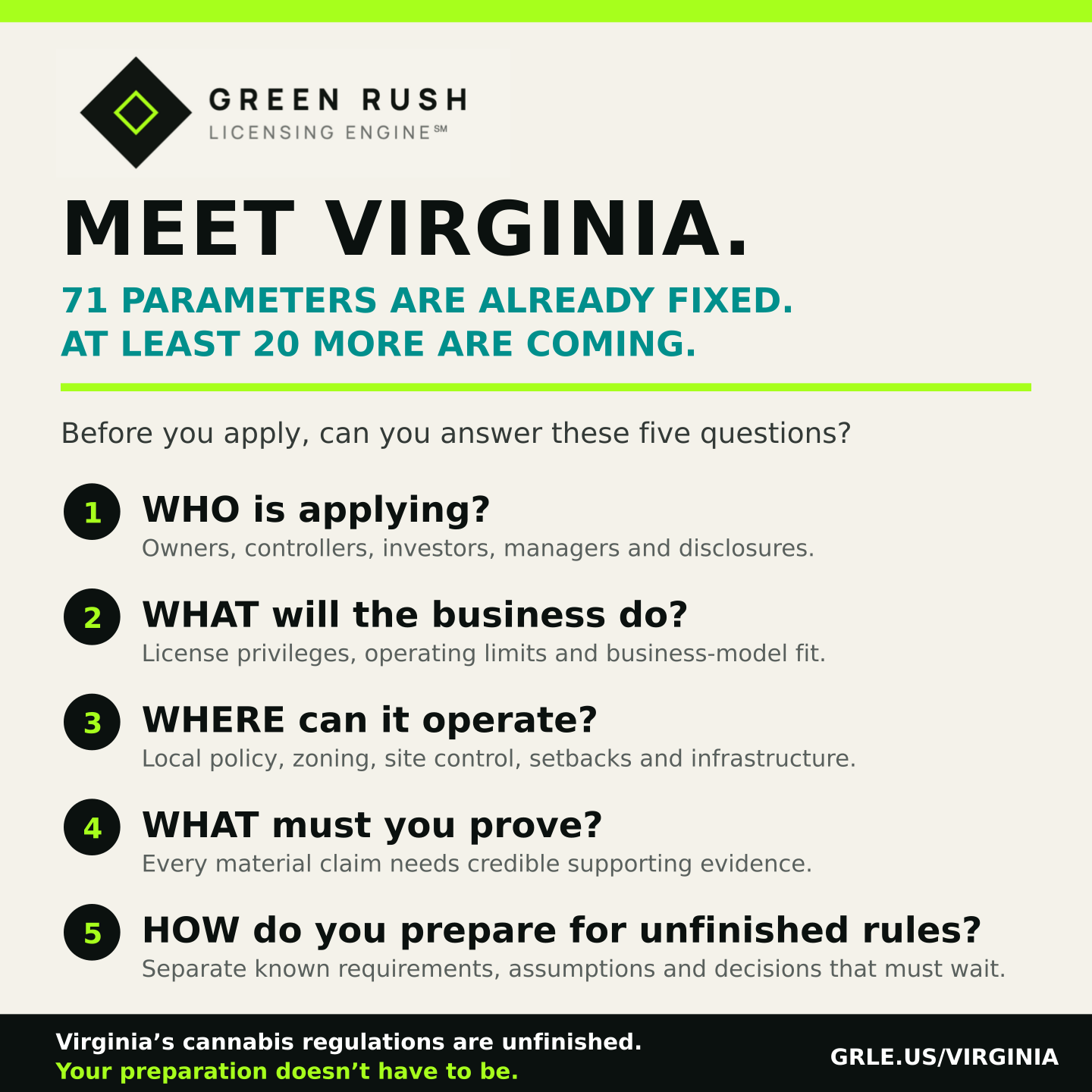
Green Rush’s analysis of Virginia’s enacted framework has identified 71 fixed statutory requirements and parameters, together with at least 20 subjects requiring further definition, regulation or implementation by the Cannabis Control Authority.
These are Green Rush’s analytical classifications, not counts published by the CCA.
The distinction between the two categories is essential.
A fixed statutory parameter is information an applicant can treat as established unless the law changes. It may define a license privilege, ownership threshold, operational limitation, premises obligation, tracking requirement or other controlling feature of the program.
An unresolved variable is different. The statute may direct the CCA to establish a standard, design a procedure, set a limit, determine documentation or otherwise supply an implementation detail through regulation or guidance.
Unknown variables do not make preparation impossible. They make disciplined classification necessary.
Every major preparation item should be placed into one of four categories:
-
Established requirements
Requirements already fixed by enacted law. -
Actionable preparation
Work that can be completed responsibly before final regulations appear. -
Working assumptions
Decisions that can be modeled provisionally, provided the assumptions are expressly identified and revisited. -
Regulatory dependencies
Matters that should not be treated as settled until the CCA supplies controlling details.
This separation prevents two opposite mistakes.
The first is paralysis: assuming nothing can be done until every regulation is final.
The second is false certainty: treating an educated prediction as though it were already law.
Serious preparation occupies the space between those mistakes.
Aggressive Preparation Is Not Reckless Commitment
“Aggressive preparation” should not mean signing an unconditional lease, purchasing specialized equipment or finalizing an inflexible ownership structure before the applicable requirements are known.
It means attacking the available work while preserving the ability to adapt.
That can include:
-
Selecting and comparing plausible license pathways
-
Identifying principals and potential disclosure parties
-
Documenting ownership and control
-
Investigating stakeholder eligibility
-
Organizing source-of-funds records
-
Developing a preliminary capitalization plan
-
Comparing target jurisdictions
-
Researching zoning and local political conditions
-
Establishing objective site-selection criteria
-
Building operating and infrastructure assumptions
-
Creating a preliminary evidence register
-
Identifying professional-service needs
-
Estimating application, construction and operating capital
-
Recording unresolved regulatory dependencies
-
Establishing decision deadlines
-
Creating alternatives for assumptions that prove incorrect
The result is not a completed application. It is a better-prepared applicant.
When final regulations, forms and guidance arrive, the prepared applicant should be able to compare them against an organized body of existing work. The unprepared applicant will be encountering foundational questions for the first time while the calendar is already moving.
California Demonstrated the Value of the Pre-Application Period
Green Rush has encountered this type of uncertainty before.
In 2016, California had approved adult-use legalization, but implementing regulations were unfinished and the application window had not opened. Prospective applicants wanted to know what they could do before the state supplied a final application.
Green Rush developed the AUMA Application Simulator.
The simulator incorporated more than 600 prospective requirements and questions. It combined what was already known about California’s developing system with application and operational lessons drawn from the comparatively mature Oregon and Washington programs.
Its purpose was not to predict every line of California’s eventual application. It was designed to expose the volume and interconnectedness of the work.
Applicants were forced to confront ownership, financing, premises, operating procedures, compliance systems, documentation, infrastructure and capital requirements before those issues became application-day emergencies.
The larger lesson was simple:
An unopened application window is not an empty period.
It is a period in which applicants can investigate, organize, model, document and prepare—provided they keep established requirements, informed assumptions and unresolved questions clearly separated.
The Virginia Cannabis Licensee Readiness Report
Green Rush developed the Virginia Module of the Green Rush Licensing Engine℠ for this preparatory interval.
Its central deliverable is the Virginia Cannabis Licensee Readiness Report, a structured decision-support product for prospective Virginia cannabis stakeholders.
The standard engagement examines:
-
One ownership group
-
One principal license pathway or operating configuration
-
One target Virginia jurisdiction
The analysis is organized through Green Rush’s proprietary Who–What–Where cannabis-application methodology.
WHO
The report examines the people, entities, ownership interests, control relationships, financing arrangements, managers, disclosure obligations and potential eligibility issues behind the proposed applicant.
WHAT
The report maps the proposed enterprise to the privileges and limitations of the selected license pathway. It tests whether the contemplated operating activities fit the authority the license is expected to provide.
WHERE
The report evaluates the proposed jurisdiction and premises strategy, including local policy, zoning, site control, land-use compatibility, infrastructure, community considerations and regulatory suitability.
The report also:
-
Identifies applicable statutory requirements and fixed parameters
-
Separates known requirements from unresolved CCA variables
-
Records important working assumptions
-
Identifies evidence that may be needed
-
Exposes gaps, conflicts and dependencies
-
Maps work that can be undertaken now
-
Identifies commitments that may need to be deferred
-
Creates a more deliberate sequence for future decisions
The standard price is $5,900, with an initial delivery standard of 15 business days following complete client onboarding.
The Readiness Report does not constitute legal advice, guarantee license selection or represent that an applicant is fully application-ready before controlling regulations, forms and procedures have been published.
Its purpose is more disciplined.
For prospective Virginia cannabis stakeholders, the Virginia Module is designed to meticulously avoid manufacturing certainty where regulators have not yet provided it. The objective is to document what is known, define what remains unresolved and help applicants make better-sequenced decisions while they still have time to change course.
Preparation Is a Competitive Advantage
Virginia’s regulated market will attract serious applicants, experienced multistate operators, well-capitalized investors, local entrepreneurs and teams assembled specifically to pursue newly available licenses.
Not every group will begin from the same position.
Some will wait for the application form and then discover that the form presupposes decisions they have not made, documents they have not collected, relationships they have not formalized and premises questions they have not investigated.
Others will use the pre-application period to build a coherent applicant, operating model, location strategy and evidence base.
Preparation cannot guarantee selection.
It can, however, reduce avoidable confusion, expose expensive assumptions, improve decision quality and give an applicant more time to correct weaknesses.
Virginia’s cannabis regulations are unfinished.
Your preparation doesn’t have to be.
To learn more about the Virginia Cannabis Licensee Readiness Report, visit:
Green Rush Advisory Group, LLC
Cannabis enterprise consulting since 2013
ford@green-rush.us
(888) 743-0569
This article is provided for general informational and business-planning purposes. It does not constitute legal advice. Prospective applicants should consult qualified Virginia legal, tax, real-estate and other professional advisers regarding their individual circumstances.